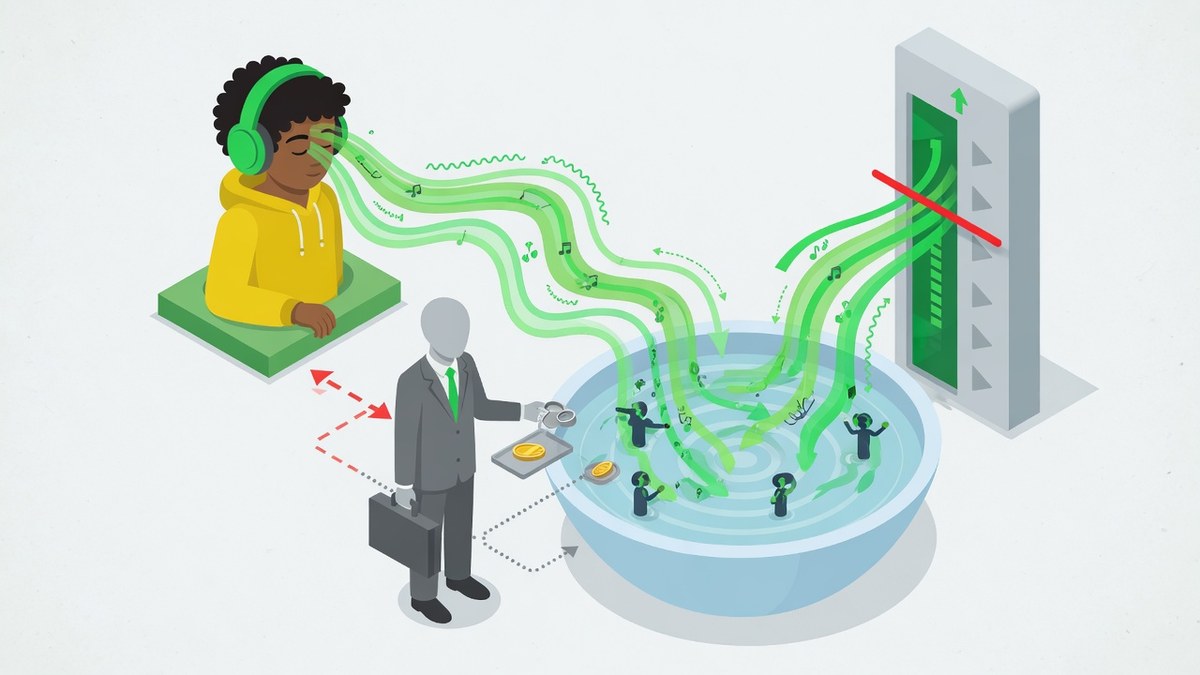
Do artists get paid from Spotify? Yes, but almost never the way people picture it. Spotify does not cut you a check, and it does not pay a set amount per stream. Your money is a share of a revenue pool, paid once a month to your label or distributor, who then pays you whatever your contract says, after their cut.
That's the honest headline, and the rest of this is the mechanics that actually decide your number: the two kinds of royalties, the streamshare math, the 1,000-stream rule that can zero out a track entirely, and what the 2026 data says real artists are earning. If you make music and you've ever squinted at a Spotify for Artists dashboard wondering where the money is, this is the map.
Spotify pays rightsholders, not artists
Start with the part that trips up almost everyone. When your song streams, Spotify owes a royalty, but it pays that royalty to the rightsholder who delivered the music, not to you as a person. In practice that's your record label or the distributor you uploaded through. From Spotify's own royalties documentation: recording royalties are "paid to artists through the licensor that delivered the music, typically their record label or distributor."
So there's always a middleman in the chain, and it matters, because Spotify pays them monthly, then they pay you on their own schedule and their own split. Spotify is blunt that it has no visibility into your deal: it says it has no knowledge of the agreements artists sign with labels or distributors, so it can't explain why a given payment lands where it does. When your payout looks strange, the answer lives with your distributor, not with Spotify.
There are actually two royalty streams flowing here, and they go to different people:
- Recording royalties — for the recording itself, paid to the label or distributor that delivered it.
- Publishing royalties — for the underlying composition, paid to songwriters and publishers through collecting societies and mechanical agencies based on where the stream happened.
If you wrote and recorded your own song and self-distribute, you may be collecting both, but often through different pipes. Most artists chasing "why is my Spotify money low" are looking only at the recording side.
There is no per-stream rate (really)
Here's the myth worth killing: the clean "Spotify pays $0.004 per stream" number you've seen quoted everywhere. Spotify does not work that way, and says so directly: "Spotify does not pay artist royalties according to a per-play or per-stream rate."
What it actually uses is streamshare. Each month, in each of its 180-plus markets, Spotify adds up net revenue from Premium subscriptions and ads (after taxes, card processing, billing, and some sales commissions come out), which forms a royalty pool worth roughly two-thirds of every dollar Spotify earns from music. Then it looks at total streams that month and pays each rightsholder a slice matching their share of them. Get 1% of the streams in a market, get 1% of that market's pool.
That's why any per-stream figure is a result, not a rate. It shifts with how many people paid for Premium that month, which markets your listeners sit in, and how much total streaming happened. The commonly cited $0.003 to $0.005 range is an after-the-fact average some artists back into, and it's a reasonable gut-check, but nobody, including Spotify, sets it in advance.
The 1,000-stream rule that can zero you out
This is the 2026 rule most small artists don't know is quietly costing them. Since April 2024, a track must hit at least 1,000 streams in the previous 12 months to earn any recording royalties at all. Miss that bar and the track generates exactly nothing.
Spotify's reasoning: tracks with between 1 and 1,000 annual streams earn about $0.03 a month on average and make up just 0.5% of all streams and royalties. That money used to get stranded, because distributor withdrawal minimums (often $2 to $50) and banking fees ($1 to $20 per withdrawal) meant it never reached the artist anyway. So Spotify reallocates it by streamshare to tracks that do clear the bar. The pool doesn't shrink and Spotify doesn't pocket it; eligible tracks each earn about 0.5% more.
A few details that matter if you're near the line:
- It's per track, not per artist. Ten songs at 900 streams each earn zero, even though that's 9,000 total plays.
- There's also an undisclosed minimum-unique-listener requirement, so botting one track to 1,000 plays won't qualify it. Spotify won't publish the exact number, on purpose.
- Eligibility isn't retroactive within a track's history but it does bank forward. If a song hits 750 streams in month one and 500 in month two, it crosses 1,000 and earns on those 500 (and every stream after, as long as it stays eligible), just not on the earlier 750.
- This applies to recording royalties only. Publishing royalties aren't affected by the threshold.
Want the full breakdown of what Spotify pays and when?
See how Spotify's payout gates workWhat artists actually earn in 2026
Spotify won't tell you a typical per-artist number, because it genuinely doesn't know your deal. What it does publish, through its annual Loud & Clear report released in March 2026, is the aggregate. Here's the honest picture at the top and middle of the distribution:
| Loud & Clear (2025 payouts) | Figure |
|---|---|
| Paid to the music industry in 2025 | More than $11 billion |
| All-time total paid | Nearly $70 billion |
| Year-over-year payout growth | More than 10% |
| Artists earning $100,000+ from Spotify | 13,800+ |
| Artists earning $1M+ | 1,500+ |
| The 100,000th-highest-earning artist | More than $7,300 |
Source: Spotify Loud & Clear, March 2026. Two things stand out. First, the middle is rising fast: the artist ranked 100,000th earned about $350 in 2015 and more than $7,300 in 2025, a twentyfold jump in a decade. Second, roughly half of all royalties go to independent artists and labels, and more than a third of artists clearing $10,000 are DIY self-releasers. You don't need a major label to reach real money here, but you do need scale, because a single stream is worth a fraction of a cent.
So, do artists get paid, and is it worth it?
Yes, artists get paid from Spotify, with three asterisks: not directly (your distributor or label collects and pays you), not per-stream (it's a monthly streamshare slice of a market pool), and not at all on any track under 1,000 annual streams. Put your music up through a distributor like DistroKid, TuneCore, or CD Baby, and you start earning the first month a track clears the threshold. There's no program to join and no follower gate, unlike the podcaster path.
Is it worth it? For almost every artist, yes, but as distribution and discovery, not as a paycheck. The per-stream economics are unforgiving until you have scale, so treat Spotify as the place your audience finds you, then stack income that pays better per fan on top of it. To sanity-check what your streams, or a completely different platform, might realistically pay, run the numbers first:
If you also make podcasts or want the other side of Spotify's money machine, can you monetize Spotify covers the Partner Program for podcasters, and can you monetize SoundCloud covers the closest alternative for musicians.
Streamshare, the 1,000-stream gate, and the podcaster path: see where Spotify's money actually flows
The full Spotify breakdown on Gemlist: how recording and publishing royalties split, why there's no per-stream rate, the eligibility thresholds that decide whether a track earns, and how the podcaster Partner Program differs from the artist royalty path.
See the Spotify program detailsFrequently asked questions
Do artists get paid directly by Spotify?
No. Spotify pays royalties to rightsholders, which almost always means your record label or the distributor you uploaded through, not you directly. Spotify's own royalties page is explicit: recording royalties are paid to artists through the licensor that delivered the music. That middleman then pays you according to whatever agreement you signed. Spotify says it has no knowledge of those contracts, so it can't tell you why a payment came to a certain amount in a certain month. If your money looks off, the conversation is with your distributor or label, not with Spotify.
How much does Spotify pay per stream in 2026?
There is no per-stream rate, and Spotify says so directly: it does not pay royalties according to a per-play or per-stream rate. Instead it uses streamshare. Spotify takes the net revenue from Premium subscriptions and ads in a given market, then pays each rightsholder a slice equal to their share of total streams that month. Third-party estimates put the effective blended payout somewhere around $0.003 to $0.005 per stream, but that is an after-the-fact average, not a rate Spotify sets or guarantees. Your real number depends on your listeners' markets, whether they're Premium or free, and your distributor or label deal.
Do you need 1,000 streams to get paid on Spotify?
Per track, yes, since April 2024. A track must reach at least 1,000 streams in the previous 12 months to be included in Spotify's recorded music royalty pool. Below that, the track generates nothing (Spotify says these earn about $0.03 a month on average and get reallocated to eligible tracks). There's also an undisclosed minimum-unique-listener rule to stop people botting a single track to 1,000 plays. This threshold applies to recording royalties only, not publishing royalties, and it's per track, not per artist.
How do I actually get paid by Spotify as an artist?
You don't join a program. You get your music onto Spotify through a distributor like DistroKid, TuneCore, or CD Baby (or through a record label), and that distributor collects your recording royalties from Spotify and pays them out to you. There's no application, no follower gate, and no consumption-hour threshold like the one podcasters face. The tradeoffs are the distributor's cut and its withdrawal rules: many charge a $1 to $20 banking fee per withdrawal and set minimum payout amounts of roughly $2 to $50.
Is it worth putting music on Spotify if the payouts are small?
For most artists, yes, because Spotify is where the listeners and the discovery are, not because any single stream pays much. Spotify paid the music industry more than $11 billion in 2025 and reports that over 13,800 artists earned at least $100,000 from Spotify alone that year, with more than a third of artists at the $10,000 level being DIY self-releasers. The per-stream economics are brutal at small scale, but streamshare plus global reach means income compounds as your catalog and audience grow. Treat Spotify as distribution and discovery, and stack other income like live shows and direct-fan platforms on top.
More from Gemlist
How Many Watch Hours to Monetize YouTube in 2026
How many watch hours to monetize YouTube in 2026: 4,000 valid public hours in 12 months plus 1,000 subs for ad revenue, or 3,000 hours at 500 subs for fan funding.
Spotify Partner Program Requirements 2026: Who Actually Qualifies
Spotify Partner Program requirements 2026: 3 episodes, 2,000 consumption hours, and 1,000 audience count in 30 days. Spotify cut the bar ~80% in January. Full breakdown.
Which Creator Programs Pay the Fastest? Instant, Weekly & Monthly Payout Guide (2026)
Ko-fi pays instantly. UnitedMasters SELECT pays daily. Fanfix pays weekly. YouTube pays monthly. Here's the complete 2026 guide to creator program payout speeds — verified, side-by-side.