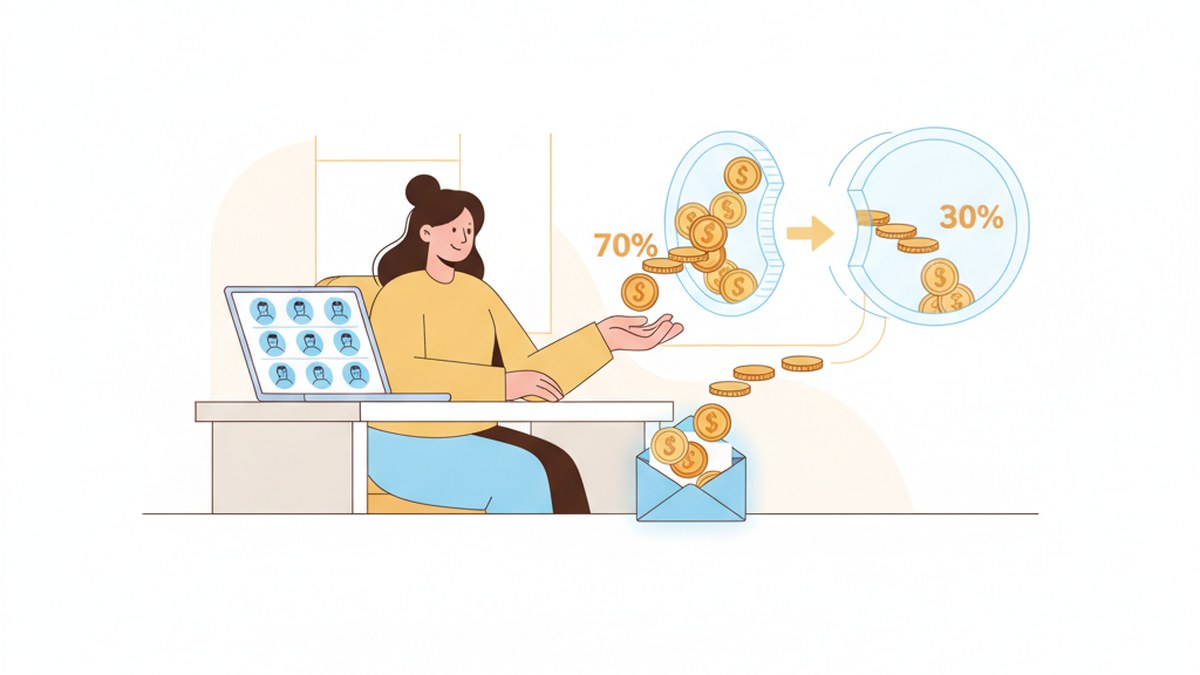
Outschool takes 30% of every class enrollment. Teachers keep 70% of the listed price, paid via PayPal after the class begins. That's the full commission structure — there's no monthly listing fee, no subscription cost, and no other platform cut.
The straightforward fee is one of the things that makes Outschool easy to evaluate before you commit. You set your price, multiply it by your enrollment count, take 70%, and that's what you net from each session. The variables are yours to control: what you charge, how many students you accept, and how many classes you run per week.
How the 30% fee works in practice
Outschool charges a 30% service fee on every enrollment, and it's a simple pass-through: you list the price, students pay it, Outschool keeps 30%, and you get 70%. The fee covers Outschool's classroom platform (the video class infrastructure), scheduling and discovery, payment processing, and the marketing that brings learners to the platform.
There's no subscription to pay, no listing fee, and no minimum earnings threshold. Unlike platforms that charge a flat monthly fee regardless of whether you earn anything, Outschool only earns when you do. That's genuinely creator-friendly for teachers who are still testing whether a subject sells.
Here's how the math looks at different price points and class sizes:
| Listed price | Students | Gross | You keep (70%) | Outschool keeps (30%) |
|---|---|---|---|---|
| $10/student | 4 | $40 | $28 | $12 |
| $20/student | 6 | $120 | $84 | $36 |
| $35/student | 8 | $280 | $196 | $84 |
| $50/student | 10 | $500 | $350 | $150 |
The fee percentage is flat regardless of class size or price tier — Outschool doesn't offer a reduced rate for higher-volume teachers or premium pricing. The way teachers increase take-home is by optimizing the inputs they control: price per enrollment, class size cap, and frequency.
What teachers actually earn
Outschool states that its most popular teachers earn up to $550 per week. That's the platform's own published benchmark — it reflects teachers who have built a consistent schedule of well-attended classes at sustainable price points, not outliers doing single high-ticket sessions.
Working backward from that figure: $550/week at 70% means roughly $785/week in gross enrollment revenue. At $25/student with a 6-student cap, that's about 5 classes per week filling to capacity. Realistic for an established teacher with repeat families; ambitious for someone in the first few months.
For teachers just starting out, income is lower and more variable. First classes often run at smaller sizes while you build reviews and visibility on the platform. Outschool's search algorithm surfaces classes with more bookings and better ratings, so early traction compounds. A well-reviewed class that consistently fills earns more per hour of effort than a new listing competing for attention.
What you need to start teaching on Outschool
The entry bar is lower than traditional teaching platforms, but there are two non-negotiable requirements:
Criminal background check. Every Outschool teacher must pass a background check before their first class begins. Since you're teaching minors, this is a firm requirement — there's no path around it. Outschool runs this as part of the onboarding process; it's not something you arrange separately.
Residency in a supported country. Outschool currently accepts teachers from the United States, Mexico, Canada, Australia, New Zealand, South Korea, Spain, and the United Kingdom. If you're not in one of those eight countries, the platform isn't open to you yet.
Beyond those two requirements, Outschool is genuinely open. There's no credential requirement, no minimum follower count, no prior teaching experience requirement. Plenty of Outschool teachers are subject enthusiasts, hobbyists, and working professionals in their field rather than licensed educators. If you have knowledge and can design a structured learning experience for learners up to age 18, you can apply.
The application is reviewed by Outschool's Tutor Success team within 5 business days. You'll provide basic personal information, a headshot, a description of your teaching strengths, and a short (up to 2 minutes) video introduction.
Outschool fees, requirements, and what teachers actually earn
See the full Outschool breakdown on GemlistHow Outschool compares to other education platforms
Outschool vs Skillshare: Skillshare pays a royalty based on watch minutes from paying Skillshare members, not per-enrollment. There's no per-student fee structure — you get a share of a pool based on engagement, not a 70% cut of listed price. Outschool's model is more transparent for teachers who want to know exactly what a class earns before they list it. How much do Skillshare teachers make breaks down the royalty pool in detail.
Outschool vs other tutoring platforms: Platforms like Preply use a declining commission structure where the platform takes a higher cut early on (including 100% of a trial lesson with a new student) and reduces the commission as you accumulate hours. Outschool's flat 30% is simpler and more predictable, though it doesn't reward longevity with a lower rate the way declining structures do.
Outschool vs self-hosting: Hosting your own courses through a platform like Teachable or Podia gives you control over pricing and keeps more revenue per student — most self-hosting platforms charge a flat monthly fee and take little or no revenue share. The trade-off is that you build your own audience rather than appearing in Outschool's existing search results. Outschool's discovery advantage is worth something; how much depends on how established your own audience already is.
Who Outschool works best for
Outschool is best suited for educators and subject experts who:
- Can design structured, live online classes for learners up to age 18
- Don't have a pre-existing audience to sell courses to directly
- Want to test whether a subject or format resonates before building infrastructure
- Can commit to running classes consistently (Outschool rewards established, well-reviewed teachers)
- Are comfortable with PayPal as a payout method
The 30% commission is standard for a marketplace that handles all the infrastructure — classroom, scheduling, discovery, payments, and trust/safety. If you're building a side income from teaching and don't want to manage your own platform, Outschool's structure is clean and predictable. If you're running enough volume that 30% is painful, that's also the point where building a direct-to-student offering starts making more economic sense.
For teachers who can't pass the background check, aren't in a supported country, or prefer self-paced over live formats, Skillshare and Maven's cohort-based course platform are the main alternatives worth evaluating in the education creator space.
- Best for
- Subject experts and educators who can teach live online classes for kids and teens and want discovery without building their own audience first
- Pay model
- 70% of enrollment revenue per class (Outschool keeps 30%). Most popular teachers earn up to $550/week — Outschool's published benchmark. Paid via PayPal after each class begins. Individual earnings depend on price, class size, and how often you teach.
- Access
- Free to list; criminal background check required; must reside in one of 8 supported countries (US, Mexico, Canada, Australia, New Zealand, South Korea, Spain, UK)
Outschool's 30% commission is straightforward: you know your take before you set your price, and the platform earns nothing unless you do. The ceiling for active teachers is real — up to $550/week for popular instructors — but it takes time to accumulate the reviews and visibility that fill classes consistently. The background check is the only hard gate beyond country eligibility, and the absence of a credential requirement genuinely opens this to knowledgeable subject experts who aren't licensed educators. Whether Outschool is worth 30% depends mostly on whether Outschool's discovery is worth more to you than the revenue you'd keep running a self-hosted platform.
Full Outschool fee structure, requirements, and what teachers earn
The complete Outschool listing on Gemlist: 30% commission explained, background check and country requirements, how PayPal payouts work, what popular teachers earn, and how Outschool compares to Skillshare and other education platforms.
See the Outschool breakdown on GemlistFrequently asked questions
How much does Outschool take from teachers?
Outschool takes a 30% service fee from every class enrollment. Teachers keep 70% of the listed class price — this applies to every enrollment, regardless of subject, class format (one-time, ongoing, camp), or how many students join. Outschool does not charge a monthly fee to list classes, so the 30% cut is the only cost.
How much do Outschool teachers make?
The most popular Outschool teachers earn up to $550 per week, according to Outschool's official data. Actual earnings depend on the number of classes you run, your listed price per enrollment, and how many students join each session. A one-time class with 6 students at $20/enrollment earns the teacher $84 (70% of $120 gross). Teachers set their own prices and class sizes, so income potential scales with schedule and demand.
Does Outschool require teaching credentials?
No. Outschool does not require formal teaching credentials — many teachers on the platform are subject experts, hobbyists, or experienced practitioners rather than licensed educators. However, every teacher must pass a criminal background check before their first class begins. You also need to be a resident of one of Outschool's supported countries: the United States, Mexico, Canada, Australia, New Zealand, South Korea, Spain, or the United Kingdom.
How does Outschool pay teachers?
Outschool pays teachers via PayPal, after the class begins. You set your listed price and the number of participants when you create the class. Once the session starts, Outschool processes the payment and sends 70% of gross enrollment revenue to your PayPal account. There is no monthly payout cycle delay — payment is tied to when each class runs.
What subjects can you teach on Outschool?
Outschool is broadly open: teachers offer academic subjects (math, science, writing, coding), languages, creative skills (art, music, crafting), hobbies, test prep, social skills, and more — for learners up to age 18. You don't need to teach a traditional school subject. If you have genuine experience or passion in a topic and can design a structured class for kids or teens, it can be listed on Outschool.
More from Gemlist
How Many Watch Hours to Monetize YouTube in 2026
How many watch hours to monetize YouTube in 2026: 4,000 valid public hours in 12 months plus 1,000 subs for ad revenue, or 3,000 hours at 500 subs for fan funding.
Creator Monetization Platforms 2026: Complete Guide by Category
How do creators make money in 2026? This guide covers 69 verified creator programs across 9 categories — video, streaming, music, gaming, writing, newsletter, beauty, education, and AI tools — with real payout rates and entry requirements.
How Much Does Ream Stories Take? Author Fees & Payouts (2026)
How much does Ream Stories take from authors? A flat 10% platform fee plus standard card processing (~2.9% + $0.30). Free to start. Here's the real math.