
Rumble pays creators somewhere between $100 and $5,000+ a month, but the number you've probably seen quoted is only half the story. The $2–$10 per 1,000 views figure is the Partner Program for video uploads. The Creator Program for live streaming works on a completely different model, and if you mix them up you'll plan around the wrong paycheck.
How Rumble pays
There are two doors into Rumble money, and they don't pay the same way.
The Partner Program is the simple one. You upload video, you keep 60% of the ad revenue, and that lands around $2–$10 per 1,000 views depending on your niche and audience. That's a real per-view rate, predictable in the way YouTube's RPM is predictable. Pick a monetization-eligible licensing option at upload and you're in.
The Creator Program is the one people get wrong. It's built for live streaming, and it does not pay per view. Your earnings come out of a shared bonus pool, and your slice of that pool depends on three things: how much watch time you pull, how many brand-new users you bring to Rumble, and how many Rumble Premium signups you convert. So a streamer with 50,000 views who drives zero Premium signups can earn less than a streamer with 10,000 views whose audience actually converts. That's the whole game on the Creator Program side.
These are the listed earning ranges, not guarantees. Where you land depends heavily on which program you lean on and, for the Creator Program, how well your audience converts to Premium. The Rumble Creator Program page breaks the tiers down further.
The actual math, worked out
Let's make the per-view side concrete, because that's the number you can plan around. On the Partner Program you keep 60% of ad revenue, landing at roughly $2–$10 per 1,000 views. A channel pulling 500,000 monthly views in a mid-paying niche sits somewhere around $1,000–$3,000 a month from uploads alone. The same channel in a low-CPM niche might see the bottom of that range; a high-demand niche like finance or politics can push past it.
The Creator Program math refuses to work that cleanly, and that's the point. There's no per-view rate to multiply. Your payout is a slice of a shared bonus pool, weighted toward watch time, new signups, and Premium conversions. Two streamers with identical view counts can earn double-digit multiples apart based purely on how many viewers they push into Rumble Premium. It rewards a loyal, convertible audience over a large passive one.
What you actually need
The Partner Program bar is basically nothing: upload original content and pick a monetization-eligible licensing option. No follower minimum.
The Creator Program is where the requirements stack up. To enroll and stay eligible for payouts each month:
- 100 total followers minimum to enroll
- 30 hours streamed per month via Rumble Studio
- 200 hours of total watch time per month
- 20+ unique chatters per month
- Complete at least one raid in five separate livestreams
- Keep an active Rumble Premium account of your own
Worth flagging: the old Host Reads requirement was removed on November 25, 2025. If you read an older guide telling you to run host-read ad campaigns to get paid, that's outdated.
See Rumble's full pay breakdown — both programs and every requirement.
View Rumble programThe catch
Rumble vs YouTube: the honest comparison
The headline number favors Rumble: a 60% ad-revenue share is more generous than YouTube's standard split, and $2–$10 per 1,000 views can beat YouTube's RPM in some niches. But percentage isn't payout. YouTube's vastly larger audience and mature ad inventory usually win on total dollars, even at a lower cut.
Where Rumble genuinely competes is audience fit. If you make political, news, or commentary content, Rumble's viewers show up for it in a way that converts better than the same content buried in YouTube's algorithm. The platform's real edge isn't a higher number on paper; it's a smaller, stickier audience that's easier to monetize directly.
Is it worth it?
- Best for
- Political, news, and commentary creators whose audience will convert to Rumble Premium
- Pay model
- $100–$5,000+/month — 60% ad share on uploads, bonus-pool split on streams
- Access
- Partner Program open; Creator Program limited to 7 countries
If you make the kind of content Rumble's audience actually shows up for, and you can nudge them into Premium, the Creator Program can pay well above its per-view equivalent. If you can't convert your viewers, the Partner Program's flat $2–$10 per 1,000 views is the more honest number to plan around.
For most creators the smart move is to start on the Partner Program (no gate, predictable per-view pay) and only chase the Creator Program once you've proven your audience converts. Rumble sits in the broader video creator category alongside a handful of platforms with very different pay models, so it's worth comparing before you commit your streaming hours. If you stream live, read does Kick pay streamers for the other side of that decision, or scan the best video platform programs for the full set.
Want to sanity-check what your view counts and conversion rate could actually pay on Rumble? Run them through the earnings calculator before you build your schedule around either program.
Get the exact Rumble pay numbers before you stream
Both programs, the bonus-pool math, the 7-country limit and every requirement — laid out in one place on Gemlist.
See Rumble's full pay breakdownFrequently asked questions
How much does Rumble pay per 1,000 views?
The Partner Program (video uploads) pays $2–$10 per 1,000 views, and creators keep 60% of ad revenue. The Creator Program (live streaming) doesn't pay per view at all. Your share there comes from a bonus pool split by watch time, new user signups, and Rumble Premium conversions you drive, so two streamers with the same view count can earn very different amounts.
Does Rumble pay more than YouTube?
Rumble's 60% ad revenue share is higher than YouTube's standard split, and the Partner Program's $2–$10 per 1,000 views can beat YouTube RPM in some niches. But YouTube's larger audience and ad inventory often produce higher total earnings despite the lower percentage. Rumble's real edge is for political, news, and commentary creators whose content lands better with Rumble's audience.
Is the Rumble Creator Program worth it?
It's worth it if you can drive Rumble Premium signups and hit the monthly minimums: 100 followers, 30 hours streamed, 200 hours watch time, and 20+ unique chatters. The catch is you have to keep an active Rumble Premium subscription yourself, and payouts come from a shared bonus pool, not a flat per-view rate. If your audience won't convert to Premium, the Partner Program is the safer bet.
What countries is the Rumble Creator Program available in?
Only seven: Australia, Canada, El Salvador, Macedonia, South Korea, the United Kingdom, and the United States. If you're located anywhere else, you can't join the Creator Program, though the Partner Program for video uploads is more broadly accessible.
What's the minimum to monetize on Rumble?
The Partner Program (video uploads) has no follower minimum. Just pick a monetization-eligible licensing option when you upload. The Creator Program (live streaming) needs 100 total followers to enroll, plus 30 hours streamed per month, 200 hours of watch time, and 20+ unique chatters to actually qualify for payouts.
More from Gemlist
How Many Watch Hours to Monetize YouTube in 2026
How many watch hours to monetize YouTube in 2026: 4,000 valid public hours in 12 months plus 1,000 subs for ad revenue, or 3,000 hours at 500 subs for fan funding.
How to Get Facebook Content Monetization in 2026
How to get Facebook Content Monetization in 2026: it's invite-only, so here's how to express interest, qualify, and land on Meta's next invite wave.
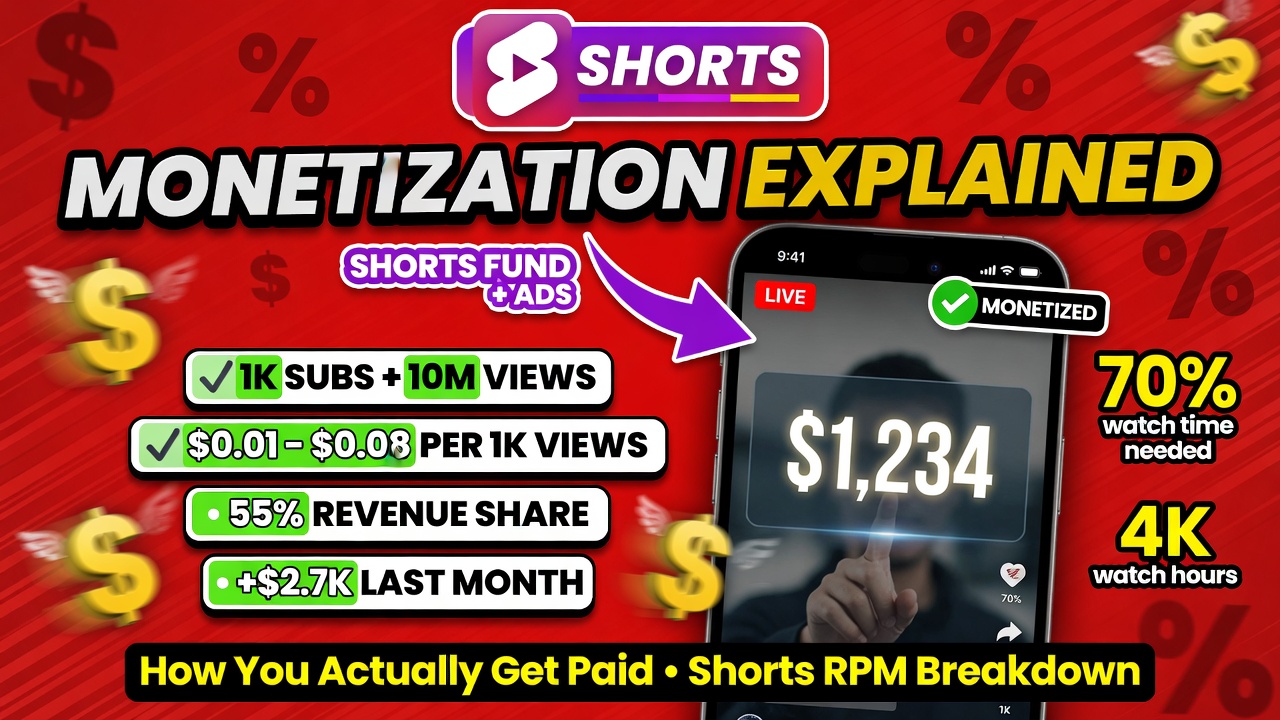
How Much Does YouTube Shorts Pay Creators in 2026
YouTube Shorts pays 45% of ad revenue — but the per-view rate is far lower than long-form. Here's what Shorts creators actually earn and what it takes to qualify.