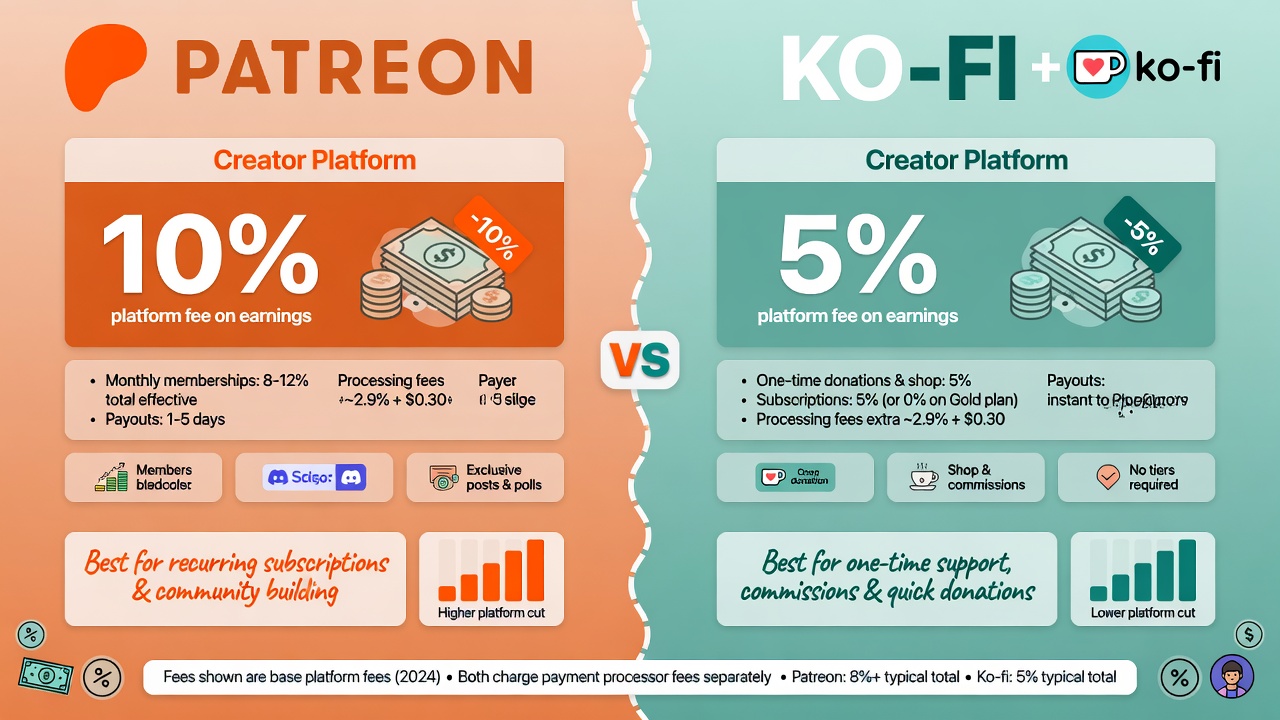
Ko-fi is cheaper on fees — always. Ko-fi's free plan takes 5% versus Patreon's 10% for new creators, and Ko-fi Gold removes the platform fee entirely for a flat monthly subscription. On raw percentage, Ko-fi wins every time.
But fees aren't the whole story. Patreon is a dedicated membership platform with deeper recurring subscription infrastructure, tier management, and a larger existing creator ecosystem. Ko-fi is more flexible — tips, commissions, a digital shop, and memberships all coexist in one lightweight storefront.
Which puts more money in your pocket depends on what you're building.
Fee comparison at a glance
| Patreon (new creators) | Ko-fi Free | Ko-fi Gold | |
|---|---|---|---|
| Platform fee | 10% | 5% | 0% |
| Payment processing | Yes (extra) | Yes (extra, via PayPal/Stripe) | Yes (extra, via PayPal/Stripe) |
| Monthly subscription cost | None | None | Flat monthly (verify on Ko-fi) |
| Payout schedule | Monthly | Instant (direct to PayPal/Stripe) | Instant (direct to PayPal/Stripe) |
| Follower minimum | None | None | None |
Legacy Patreon creators (signed up before August 4, 2025) are still on the old tiered structure: 5% (Lite), 8% (Pro), or 12% (Premium). Legacy Lite users paying 5% are at parity with Ko-fi free — same percentage, though Patreon's feature set is different at that plan level.
The break-even math
Ko-fi free vs Patreon: Ko-fi free (5%) is always cheaper than Patreon (10%) for new creators, at any income level. At $500/month, Patreon takes $50 while Ko-fi takes $25. At $1,000/month, that gap doubles to $100.
Ko-fi Gold vs Ko-fi free: Ko-fi Gold removes the 5% fee for a flat monthly subscription. If Ko-fi Gold costs $8/month, you break even when your monthly Ko-fi earnings hit $160 (5% × $160 = $8). Below $160/month, the free plan is cheaper. Above $160/month, Gold saves money on fees.
Ko-fi Gold vs Patreon: Ko-fi Gold beats Patreon almost immediately. If Gold costs $8/month and Patreon takes 10%, you'd need only $80/month on Patreon before Ko-fi Gold's flat fee is already cheaper (10% × $80 = $8). At $500/month, Ko-fi Gold costs $8 versus Patreon's $50 — a $42/month difference, before payment processing.
Important: Ko-fi's current Gold pricing can change. Verify the current monthly cost directly on Ko-fi before making the calculation.
What Patreon's 10% buys you
The 10% fee isn't arbitrary — it comes with Patreon's full platform. Membership tier management, monthly and annual subscriptions, audio and video hosting, newsletters, community chats, analytics, and Patreon's own payment infrastructure including tax collection in required markets. It's a mature, full-stack membership platform with years of creator tooling built in.
Patreon's strengths:
- Recurring subscription focus: tiers, annual discounts, monthly billing cycles all built in
- Content hosting: audio, video, text, and livestreams on-platform
- Discovery: Patreon has an explore page, though it's not a primary traffic driver
- Established ecosystem: recognizable brand that supporters already know
The 10% cost is real, but so is the infrastructure you're paying for.
What Ko-fi's 5%/0% buys you
Ko-fi is deliberately lightweight. A creator page that handles tips, memberships, commissions, a digital shop, and wishlists — all on one profile. The free plan takes 5% across all of these. Ko-fi Gold removes the fee.
Ko-fi's strengths:
- One-time support: the core product is a "buy me a coffee" model — low-commitment for supporters
- No recurring pressure: supporters can tip once without becoming a member, which reduces friction
- Commissions and shop: Ko-fi supports direct commission requests and digital product sales alongside tips
- Faster payouts: direct to PayPal or Stripe immediately, not on a monthly schedule
Ko-fi is the better fit if your audience relationship is more casual — "support when you can" rather than "subscribe monthly."
Feature comparison
| Feature | Patreon | Ko-fi |
|---|---|---|
| Membership tiers | ✅ Full tier system | ✅ Basic membership support |
| One-time tips | ✅ (one-time payments) | ✅ Core feature |
| Digital shop | ❌ Not built-in | ✅ Built-in |
| Commissions | ❌ Not built-in | ✅ Built-in |
| Audio/video hosting | ✅ | Limited |
| Newsletter | ✅ | ✅ |
| Community/chat | ✅ | Limited |
| Annual subscriptions | ✅ | ✅ (Gold) |
When to choose Patreon
Choose Patreon if you're building a dedicated monthly membership with structured tiers — different reward levels, gated content, audio/video posts, and a community you want to keep inside one platform. Patreon's infrastructure handles the complexity of recurring billing, tier access, and content delivery better than Ko-fi's more lightweight setup.
Patreon also makes sense if your audience already has Patreon accounts (which many creators' audiences do), removing sign-up friction for them.
When to choose Ko-fi
Choose Ko-fi if you want a flexible fan support layer — tips, commissions, a shop, and optional memberships — without the overhead of a full membership platform. Ko-fi's 5% free / 0% Gold fee structure means more of every transaction goes directly to you, and the instant payouts to PayPal or Stripe skip Patreon's monthly payout cycle.
Ko-fi is also the better starting point if you're not ready to commit supporters to recurring membership — the low-friction tip model gets supporters paying before they're ready to subscribe.
Can you use both?
Yes, and many creators do. A Patreon for monthly subscribers who want structured tiers and gated content, a Ko-fi for everyone else who wants to tip or buy something without committing to a membership. Neither platform restricts you from running the other simultaneously. The main cost is managing two platforms, which most creators find manageable once both are set up.
Which to pick if you're starting now
For a new creator starting in 2026 with no existing audience: Ko-fi's free plan (5% fee) is the lowest-barrier entry point. No approval, no follower minimum, and you keep 95% before payment processing. Once monthly earnings consistently exceed Ko-fi Gold's break-even threshold, upgrade to Gold.
For a creator with an existing audience who wants to build recurring membership income: Patreon's infrastructure is purpose-built for this. The 10% fee is higher, but the platform handles the subscription complexity you'd otherwise build yourself.
For a creator who already has Ko-fi or Patreon: switching costs are real (you'd need to migrate subscribers). If you're already on Patreon and earnings are meaningful, calculate what Ko-fi Gold would cost vs your current 10% before deciding whether to move.
- Best for
- Pay model
- Access
Patreon's 10% fee is higher than Ko-fi's in every scenario, but the platform delivers a mature, full-stack membership experience — tiers, content hosting, community, and recurring billing infrastructure. The right choice if building a structured paid membership is your primary goal.
- Best for
- Pay model
- Access
Ko-fi is the lower-fee option in every scenario: 5% free, 0% on Gold. Combined with instant payouts and flexibility across tips, commissions, and a shop, it's the better fit for creators who want fan support without the overhead of a full membership platform.
Frequently asked questions
Does Patreon or Ko-fi take more fees from creators?
Patreon takes more. New creators on Patreon (signed up after August 4, 2025) pay a 10% platform fee. Ko-fi's free plan takes 5% — exactly half. Ko-fi Gold removes the platform fee entirely (0%), though Gold costs a flat monthly subscription. On percentage terms, Ko-fi is always cheaper than Patreon for new creators.
Is Ko-fi better than Patreon for small creators?
Generally yes, for small creators just starting out. Ko-fi has no approval process, no follower minimum, and a 5% fee on the free plan versus Patreon's 10%. Both are free to join with no earnings threshold. Ko-fi's lower percentage fee means you keep more from each transaction — which matters most when monthly earnings are small and every dollar counts.
At what monthly earnings does Ko-fi Gold beat both Ko-fi free and Patreon?
Ko-fi Gold beats the Ko-fi free plan the moment your monthly Ko-fi earnings are high enough that 5% of them exceeds the Gold subscription cost. If Gold costs $8/month, you break even at $160/month in Ko-fi earnings — above that, Gold saves money. Ko-fi Gold (0% + flat fee) beats Patreon (10%) at even modest earnings, since 10% of $100 is $10 already exceeding a typical Gold subscription. Verify the current Gold price on Ko-fi before subscribing, as pricing can change.
Can you use Patreon and Ko-fi at the same time?
Yes. Neither Patreon nor Ko-fi requires exclusivity. Many creators run both simultaneously — a Patreon for monthly membership subscribers and a Ko-fi for one-time tips, commissions, or a digital shop. The platforms serve slightly different use cases, and running both is a common strategy for diversifying fan income. Just make sure your audience knows which platform to use for what.
Which platform is better for one-time tips versus ongoing memberships?
Ko-fi is purpose-built for one-time tips and optional payments — supporters 'buy you a coffee' without committing to recurring payments. It also supports memberships and commissions. Patreon is primarily a recurring membership platform with a strong subscription focus, though it also supports one-time payments. If your audience mostly wants to tip or buy things occasionally, Ko-fi is the natural fit. If you want to build a paid membership with tiers, both work, but Patreon has more mature membership infrastructure.
More from Gemlist

Which Creator Programs Pay the Fastest? Instant, Weekly & Monthly Payout Guide (2026)
Ko-fi pays instantly. UnitedMasters SELECT pays daily. Fanfix pays weekly. YouTube pays monthly. Here's the complete 2026 guide to creator program payout speeds — verified, side-by-side.

How Much Does OnlyFans Take? Creator Fees & 5 Alternatives (2026)
OnlyFans takes a flat 20% from all earnings — subscriptions, tips, PPV, and custom content. You keep 80%. Here's the real math plus 5 alternatives that charge less.

Twitch vs YouTube for Streamers in 2026: Which Pays More?
Twitch pays $2.50 per Tier 1 sub on a 50/50 split. YouTube pays 55% of ad revenue from your first day in YPP. For small streamers, YouTube's ad model often outpays Twitch's sub model — here's the breakdown.