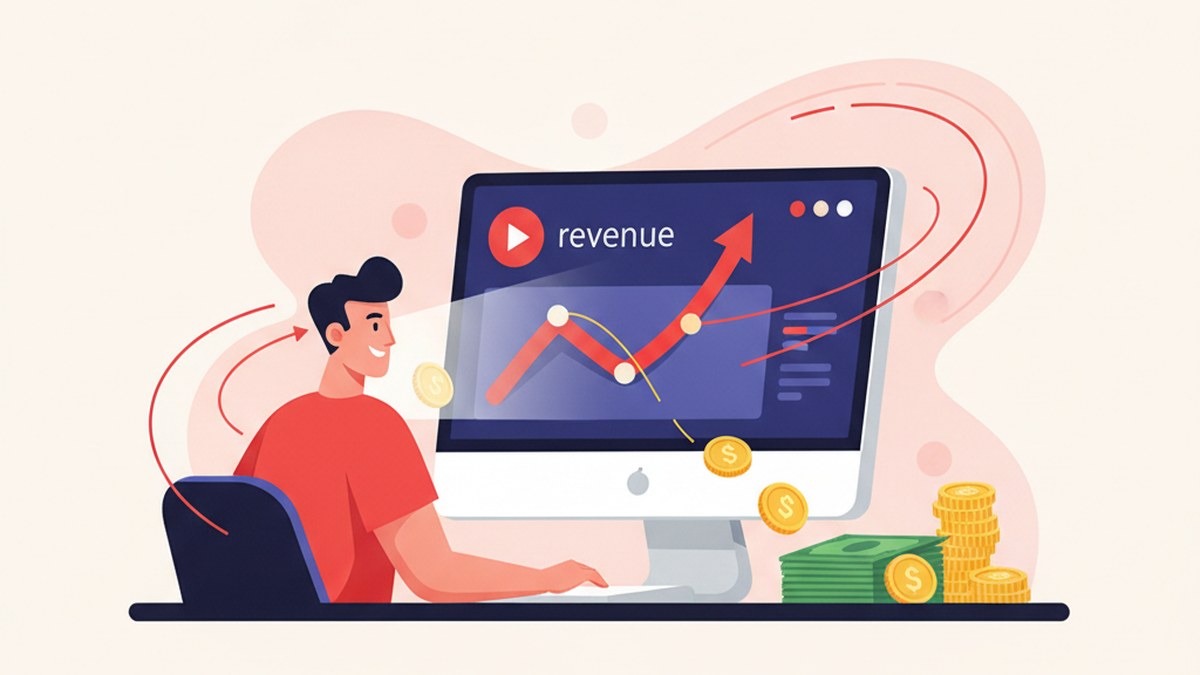
YouTube pays creators 55% of the ad revenue on long-form videos and 45% on Shorts. Those are the official splits, published in the YouTube Partner Program terms. What those percentages translate to per 1,000 views is a harder question. Creators commonly report $1–$5 RPM for mainstream content, with finance, software, and B2B channels regularly seeing $10–$20+. Entertainment and gaming tend to sit at the low end. The spread is wide because it depends on your niche, where your viewers live, and what time of year it is. YouTube's generosity (or lack of it) isn't the main variable.
How the 55% split actually works
YouTube sells ads that run before, during, and alongside your videos. Advertisers pay for impressions and clicks. YouTube keeps 45% of what they pay and passes 55% to you. That's the deal on long-form content.
The part that changes the math is that the 55% doesn't apply to every view you get. It applies to ad-monetized views, which are a subset of your total. Some views come from countries where YouTube sells very little advertising. Some come from viewers using ad blockers. Some come from the viewer skipping before the ad counts as a paid impression. None of those earn you anything.
That's why RPM (revenue per mille, meaning revenue per 1,000 total views) is a more useful number than the split percentage in isolation. RPM is what actually hits your account after everything is factored in, including the views that earned zero. It's the number that answers "what does this channel actually make."
YouTube doesn't publish an RPM benchmark. What you'll find in public creator disclosures, forum threads, and analytics platforms is a range, and that range is the honest answer.
What you need before any of this applies
The YouTube Partner Program requires an application and doesn't turn on automatically. You have to clear the thresholds and get accepted before YouTube runs ads on your content.
The full monetization requirements in 2026:
- 1,000 subscribers
- 4,000 valid public watch hours in the last 12 months, OR 10 million valid public Shorts views in the last 90 days
There's an earlier tier called expanded YPP that unlocks fan funding features (Super Chat, Super Thanks, channel memberships) at 500 subscribers, 3 public uploads in 90 days, and either 3,000 watch hours or 3 million Shorts views. But ad revenue specifically, the 55% split, doesn't start until you clear the full 1,000/4,000 bar.
The harder truth: most channels never get there. Building to 1,000 subscribers and 4,000 hours of watch time takes real time and real content. If you're planning YouTube as an income source, the first milestone isn't maximizing your RPM. It's getting monetized at all.
What you'll realistically earn per 1,000 views
The range that appears most consistently across creator disclosures and analytics platform data:
| Niche | Typical RPM (creator-reported) |
|---|---|
| Personal finance / investing | $10–$30 |
| B2B software / SaaS | $8–$25 |
| Technology / reviews | $5–$15 |
| Education / how-to | $4–$12 |
| Fitness and health | $3–$8 |
| Entertainment / vlogging | $1–$4 |
| Gaming | $1–$4 |
These are not figures YouTube publishes. They come from creator income reports and analytics platforms that aggregate channel data, like Social Blade and creator disclosures, plus community threads. Treat them as a planning range, not a guarantee.
The niche gap is significant. A personal finance channel with 100,000 monthly views can out-earn an entertainment channel with 1 million monthly views. Advertisers pay much more per impression to reach someone researching investment accounts than someone watching compilation videos. If you're picking a niche, this table is worth more than almost any other advice.
The table gives you the range. Your actual number depends on your specific niche, where your viewers live, and how much of your watch time is long-form versus Shorts — which is exactly what the calculator handles:
Plug your own numbers into the Gemlist earnings calculator to get a grounded estimate based on your niche and viewer location.
What actually moves your RPM
Geography. This is probably the biggest variable new creators miss. A viewer in the US, UK, Canada, or Australia generates substantially higher ad revenue than the same view from India or Southeast Asia. Advertisers set bids by country, and the gap between high-spend and low-spend markets can be 10x or more. A channel with a strong Indian following can have 10x more views than a comparable US-focused channel and still earn less.
Seasonality. Ad rates spike in Q4 as advertisers exhaust their annual budgets. October through December is the strongest period on the calendar. January drops off sharply. Some creators see their RPM roughly halve between December and January. This is not a YouTube decision; it's just how advertising markets work.
Video length and ad placement. Longer videos can run mid-roll ads, which means more ad impressions per view. A 15-minute video with two mid-rolls will generally out-earn a 4-minute video on the same topic. Short-form and Shorts content has lower ad density almost by design.
Content category. Even within a niche, YouTube targets ads by content signals, so a finance video about budgeting will pull different advertiser interest than one about luxury travel. The more specifically your content matches high-advertiser-intent topics, the higher your CPM tends to be.
See YouTube's full pay breakdown — ad split, Premium revenue, fan funding, and all requirements.
View YouTube Partner ProgramYouTube Shorts: the 45% and what it means in practice
Shorts runs on a different monetization structure. YouTube pools the ad revenue generated across the entire Shorts feed, deducts payments to music rights holders, then distributes the remaining pool to creators based on their proportional share of Shorts views.
You keep 45% of your allocated share. The calculation is more complex than long-form, and the per-view payout runs lower for a few reasons: the ad inventory on a short-video feed is less dense than on a dedicated video player, the pool is shared across an enormous number of creators, and the music rights deduction comes out before your cut.
Shorts is genuinely useful as a growth tool and for hitting the Shorts-specific YPP threshold (10 million views in 90 days). Building meaningful ad income around Shorts RPM alone is harder than on long-form. Creators who earn well from Shorts are typically using it as a top-of-funnel that drives subscribers to their long-form content.
The other ways YouTube pays
Once you're in the YPP, ad revenue is only one stream. Several others open up:
YouTube Premium revenue. When a Premium subscriber (who doesn't see ads) watches your video, YouTube allocates a portion of their subscription fee to you based on their watch time. This shows up in YouTube Analytics separately from ad revenue and adds a few percentage points to most creators' total earnings.
Fan funding. Super Chat (paid messages during live streams), Super Thanks (paid reactions on videos), and channel memberships pay out to creators after YouTube takes roughly 30%. For channels with engaged audiences who show up live, fan funding can come close to matching ad revenue on active streams.
Shopping. Eligible channels can tag products in videos and earn commission on sales. It's a smaller stream for most, but meaningful for product-review, tech, and tutorial channels where audience purchase intent is high.
The YouTube Partner Program page on Gemlist covers all revenue streams and how they stack up. If you want to go deeper on how much each stream pays across different channel sizes, the earnings breakdown has the specifics.
The honest catch
A few things that get skipped in most YouTube earnings posts:
The 55% applies to what YouTube earns from your video. If your video gets very few monetized playbacks (ad blockers, low-CPM country views, ads that don't match your content), 55% of a small number is still a small number. The split is fair. The ad market behind it may not suit your channel.
Ad blockers are common on desktop YouTube. A meaningful portion of any channel's audience sees no ads and generates no revenue. Your "monetized playbacks vs. views" ratio in YouTube Analytics will tell you exactly how big this gap is for your specific audience.
The threshold wait is real. Once you hit 1,000 subs and 4,000 hours, you submit an application and wait for review. Sometimes weeks. You're producing content with no ad income during that gap, and there's no guarantee of acceptance on the first submission.
Who should actually bother
YouTube's ad model works best if you can make long-form content consistently, target viewers in high-advertising-spend geographies, and are genuinely prepared to put in 12 to 24 months before the income gets meaningful.
Given all the caveats, it's still the strongest option for building scalable creator income from video. The revenue split isn't the most generous in the industry, but the audience depth and advertiser market behind it dwarf any alternative. A 2% RPM advantage on a competing platform doesn't close the gap when YouTube has 50x the audience.
If you need revenue faster and you're building around live streaming or subscriptions, the picture changes. Kick's 95% subscription split generates real income at much smaller audience sizes for streamers whose viewers will pay for subscriptions. Rumble's Creator Program runs on a 60% ad share plus a bonus pool for live content, and it rewards creators whose audience is ready to convert. Both sit in the broader video creator programs category.
For a deeper look at how those compare: does Kick pay streamers and how much does Rumble pay creators cover the specifics on each. If you want a side-by-side of all the main video platforms, best video platform creator programs has it.
- Best for
- Long-form creators in high-CPM niches (finance, software, education) who can sustain consistent output for 12–24 months
- Pay model
- 55% of ad revenue on long-form; 45% on Shorts. Creator-reported RPM: $1–$5 for mainstream content, $10–$20+ in finance and B2B.
- Access
- Application-gated; 1,000 subscribers + 4,000 watch hours required before ad revenue turns on
The 55% split is fair and the audience depth is unmatched. The real barriers are the threshold (many channels never cross it) and the RPM variance (your niche and viewer geography matter more than your raw view count). If you can clear the first hurdle and create in a reasonably high-CPM category, YouTube is still the most reliable path to scalable video income.
Everything YouTube pays — in one place
Ad split, Premium revenue, fan funding, Shorts monetization, and a side-by-side with Kick and Rumble. All on Gemlist.
See the full YouTube Partner Program breakdownFrequently asked questions
How much does YouTube pay per 1,000 views?
YouTube doesn't publish an official RPM figure. Based on creator-reported data and analytics platforms, the typical range is $1–$5 per 1,000 views (RPM) for most channels. Finance, software, and B2B channels commonly report $10–$20+ RPM. Entertainment and gaming often land at $1–$3. Your actual number depends on viewer geography, content niche, the time of year, and how many of your total views are actually ad-monetized.
How much does YouTube pay for 1 million views?
At a typical $1–$5 RPM, 1 million views would generate roughly $1,000–$5,000. In a high-CPM niche like personal finance or software, the same 1 million views could earn $10,000–$20,000+. These are creator-reported ranges, not YouTube guarantees. A meaningful share of views on any channel are un-monetized due to ad blockers, viewers in low-CPM countries, and skipped pre-rolls, so your effective RPM runs lower than your niche's gross CPM would suggest.
What are the requirements to get paid on YouTube in 2026?
To unlock ad revenue through the YouTube Partner Program, you need 1,000 subscribers and either 4,000 valid public watch hours in the last 12 months or 10 million valid public Shorts views in the last 90 days. There's also an earlier expanded YPP tier that opens fan funding features (Super Chat, channel memberships) at 500 subscribers with lower watch thresholds — but ad revenue doesn't turn on until you hit the full 1,000/4,000 bar.
Does YouTube pay for Shorts?
Yes, but on a different split. On Shorts, creators keep 45% of the ad revenue (versus 55% on long-form). YouTube pools ad revenue from the Shorts feed, deducts music rights payments, then distributes what remains to creators based on their share of total Shorts views. The effective per-view rate on Shorts runs lower than long-form because the ad inventory is less dense and the revenue pool is split across a large number of creators.
How much does YouTube pay per subscriber?
YouTube doesn't pay per subscriber. Subscribers don't generate income directly. They matter because they help videos get distributed through the algorithm, which drives views, which drives ad revenue. The income comes from what subscribers watch and whether those views are monetized — the subscriber count is the means, not the payout metric.
More from Gemlist
How Many Watch Hours to Monetize YouTube in 2026
How many watch hours to monetize YouTube in 2026: 4,000 valid public hours in 12 months plus 1,000 subs for ad revenue, or 3,000 hours at 500 subs for fan funding.
Spotify Partner Program Requirements 2026: Who Actually Qualifies
Spotify Partner Program requirements 2026: 3 episodes, 2,000 consumption hours, and 1,000 audience count in 30 days. Spotify cut the bar ~80% in January. Full breakdown.

Which Creator Programs Pay the Fastest? Instant, Weekly & Monthly Payout Guide (2026)
Ko-fi pays instantly. UnitedMasters SELECT pays daily. Fanfix pays weekly. YouTube pays monthly. Here's the complete 2026 guide to creator program payout speeds — verified, side-by-side.