
YouTube pays more per view — but TikTok is easier to go viral on, and that gap changes the math entirely. YouTube creators typically report $1–$8 in revenue per 1,000 views (RPM); TikTok Creator Rewards pays $0.40–$1.00 per 1,000 qualified views. For the same view count, YouTube generally returns 5–10x more cash. The trade-off: YouTube's content compounds through search and doesn't depend on the algorithm feeding you an audience every day.
The raw pay gap
YouTube pays you 55% of ad revenue on long-form videos and 45% on Shorts. What lands in your bank account per 1,000 views is called RPM (revenue per mille) — and YouTube doesn't publish an average because it varies enormously.
Creator-reported RPM ranges:
- Entertainment and gaming: $1–$3 per 1,000 views
- Lifestyle and food: $2–$5 per 1,000 views
- Business and marketing: $4–$8 per 1,000 views
- Finance and investing: $10–$20+ per 1,000 views
TikTok Creator Rewards pays $0.40–$1.00 per 1,000 qualified views. "Qualified" matters: TikTok only counts original content over one minute long, measured by actual engagement — play duration, replays, shares. A view that bounced in three seconds doesn't earn the same as one that finished.
Both figures are creator-reported. Neither YouTube nor TikTok publishes official average per-creator rates.
The practical takeaway: a creator who earns 1 million views on YouTube in a typical business niche earns roughly $4,000–$8,000. The same 1 million views on TikTok earns $400–$1,000. Same eyeballs, roughly 5–10x gap.
Entry requirements compared
Getting into YouTube Partner Program is actually easier than TikTok Creator Rewards, even though YouTube feels like the more established platform.
YouTube Partner Program (YPP):
- 1,000 subscribers
- 4,000 valid public watch hours in the last 12 months, OR 10 million valid public Shorts views in the last 90 days
- No active Community Guidelines strikes
Expanded YPP (fan funding via Super Chat, channel memberships — no ad revenue yet):
- 500 subscribers
- 3 valid public uploads in the last 90 days
- 3,000 watch hours (12 months) OR 3 million Shorts views (90 days)
TikTok Creator Rewards Program:
- 18 years or older
- 10,000 followers
- 100,000 video views in the last 30 days
- Personal account in good standing (business accounts not eligible)
- Original content — videos must be over one minute long
The 100K views in 30 days is the real gatekeeper for TikTok. On YouTube, watch hours accumulate over a full year — a slow build works. On TikTok, you need recent viral momentum to even start. Many creators hit 10K followers but still can't qualify because the 30-day viewership resets.
TikTok Creator Rewards: requirements, pay rates, and what qualifies a view
See the full TikTok Creator Rewards breakdownWhy TikTok's algorithm changes the math
TikTok's distribution model is fundamentally different. New creators with zero followers regularly get 50K–500K views on their first few posts because TikTok's algorithm tests content against broad audiences before deciding whether to keep pushing it. Instagram and YouTube do not work this way — both lean heavily on existing audience reach.
That matters for earnings calculations in both directions. Yes, TikTok pays less per view. But a creator who posts on TikTok for three months might hit 5 million views while a comparable creator grinding YouTube Shorts gets 200K. The absolute dollar amount from those 5 million TikTok views — around $2,000–$5,000 — is still real money a YouTube Shorts creator wouldn't have earned yet.
The other factor is speed of monetization. On YouTube, you're typically waiting 6–18 months to hit 1,000 subscribers and 4,000 watch hours. On TikTok, the 30-day requirement means you could potentially qualify faster if a video hits — but you're also one bad month away from dropping below the threshold.
Long-form vs short-form economics
YouTube's most underrated advantage is how its content compounds. A YouTube video about "how to invest $1,000" published in 2024 still earns ad revenue in 2026 because search keeps sending people to it. TikTok content has a roughly 24–72 hour shelf life — after that, the algorithm stops distributing it and it earns nothing.
This means YouTube income is sticky in a way TikTok isn't. A creator with 50 long-form YouTube videos that each earn a modest $50/month has built a base of $2,500/month in near-passive income. A TikTok creator with the same audience size has to keep posting to keep earning.
Shorts and TikTok are more comparable to each other: both are algorithm-driven, both have short shelf lives, and YouTube Shorts at 45% revenue share pays in a similar range to TikTok Creator Rewards. Neither is a reliable primary income source at small scale.
The niche factor is everything
"$1–$8 RPM" is a wide range, and it's mostly explained by the advertiser competition for your audience.
Finance content gets $10–$20 RPM because finance advertisers (credit cards, brokerages, insurance) pay a lot per click. Gaming content gets $1–$3 RPM because gaming advertisers' budgets are smaller and the audience skews younger. TikTok doesn't have the same niche-based differentiation — $0.40–$1.00 is roughly the range across all content types, with minor variation by niche.
If you create finance, investing, business, or SaaS content, YouTube is a dramatically better money platform. The same video on YouTube Finance earns 10–20x what it would on TikTok.
If you create entertainment, comedy, or trend-based content where the money is in brand deals and merchandise rather than platform payouts, the per-view gap matters less — TikTok's reach advantage may outweigh it.
How most creators actually use both
The playbook that's worked for a lot of creators: post on TikTok to build an audience fast (the algorithm gives new creators way more reach than YouTube or Instagram), then funnel that audience to YouTube where the long-term income compounds.
Concretely: a TikTok clip teases a longer video ("full breakdown on YouTube"), the YouTube video earns 5–10x more per view, and the YouTube search presence keeps bringing in new viewers long after the TikTok post is forgotten.
Neither platform's built-in monetization is a business on its own at small scale. TikTok Creator Rewards and YouTube ad revenue are typically 20–30% of a full-time creator's income — the rest comes from brand sponsorships, affiliate commissions, merchandise, and courses. Both platforms are better understood as reach channels that help you sell things, with the built-in payout as a bonus.
For other platforms worth stacking alongside YouTube and TikTok, see how much Instagram pays (Reels revenue sharing for comparison), how much Rumble pays (a YouTube alternative with higher RPM for some content types), and our best video platform creator programs roundup.
Use our creator earnings calculator to model what your current view count would earn across platforms — it pulls real data from our program database and gives you a side-by-side comparison with your actual numbers.
- Best for
- Creators building long-term compounding income from search, especially in finance, business, tech, and educational niches where advertiser CPMs are highest
- Pay model
- 55% of ad revenue on long-form (45% on Shorts); creator-reported RPM $1–$8 typical, $10–$20+ for finance/tech. Individual earnings are COULDNT_CONFIRM — YouTube does not publish average RPM figures.
- Access
YouTube wins on per-view rate by a wide margin, and it's the only platform where content keeps earning years after you publish it. The 1K subscriber + 4K watch hours bar is genuinely achievable and the search-driven model means you're building an asset, not just chasing the algorithm. The trade-off is that growing on YouTube is slow and the niche you're in determines whether the economics work at all. If you're in a low-CPM niche and counting on YouTube ad revenue alone, you'll need real volume before it feels like income.
- Best for
- Creators who want to grow an audience fast and are willing to pair the platform's low per-view payout with brand deals, affiliate income, or off-platform products
- Pay model
- $0.40–$1.00 per 1,000 qualified views (creator-reported). TikTok does not publish official rates. Individual earnings are COULDNT_CONFIRM.
- Access
TikTok pays less per view than YouTube — full stop. But the distribution advantage for new creators is real: the algorithm will push your content to cold audiences in a way YouTube simply won't for an unestablished channel. If your content can go viral, TikTok gets you there faster. The catch is that Creator Rewards income alone is thin at any realistic view count, and the 100K views in 30 days requirement means qualifying can be stop-and-start. Treat it as a growth channel first, income second.
Full YouTube vs TikTok program comparison — requirements, pay rates, and what's verified
The complete YouTube Partner Program and TikTok Creator Rewards listings on Gemlist: verified requirements, how ad revenue sharing works, what qualifies a view, and how each platform's pay compares across niches.
See the YouTube Partner Program breakdown on GemlistFrequently asked questions
Does YouTube or TikTok pay more per view?
YouTube pays more per view. YouTube creators typically report $1–$8 RPM (revenue per 1,000 views), with finance and tech niches reaching $10–$20. TikTok Creator Rewards pays $0.40–$1.00 per 1,000 qualified views (creator-reported). For the same view count, YouTube generally delivers 5–10x more revenue than TikTok.
What are the requirements for YouTube Partner Program vs TikTok Creator Rewards?
YouTube Partner Program requires 1,000 subscribers plus either 4,000 valid public watch hours in the last 12 months or 10 million Shorts views in the last 90 days. TikTok Creator Rewards requires 18+, 10,000 followers, and 100,000 video views in the last 30 days — significantly higher bar. YouTube's bar is lower to start.
Can you make a living on TikTok Creator Rewards alone?
It's very difficult to live on TikTok Creator Rewards alone. At $0.40–$1.00 per 1,000 views, you'd need 1–2.5 million views per month to earn $1,000. Most creators who earn meaningful income from TikTok combine Creator Rewards with brand deals, affiliate commissions, and off-platform sales.
How much does YouTube pay per 1,000 views?
YouTube doesn't publish a fixed rate per 1,000 views — you earn 55% of ad revenue, which varies by niche, audience location, time of year, and ad format. Creator-reported RPM (what you actually receive per 1,000 views) ranges from $1–$3 for entertainment and gaming, $3–$8 for business and lifestyle, and $10–$20+ for finance and tech niches.
Should I post on YouTube or TikTok if I want to make money faster?
TikTok is faster to go viral (the algorithm aggressively distributes new creator content), but YouTube pays more per view and builds compounding revenue through search. For fastest monetization, TikTok to build an audience quickly, then YouTube for long-term income. Many creators use TikTok short clips to drive subscribers to YouTube long-form.
More from Gemlist
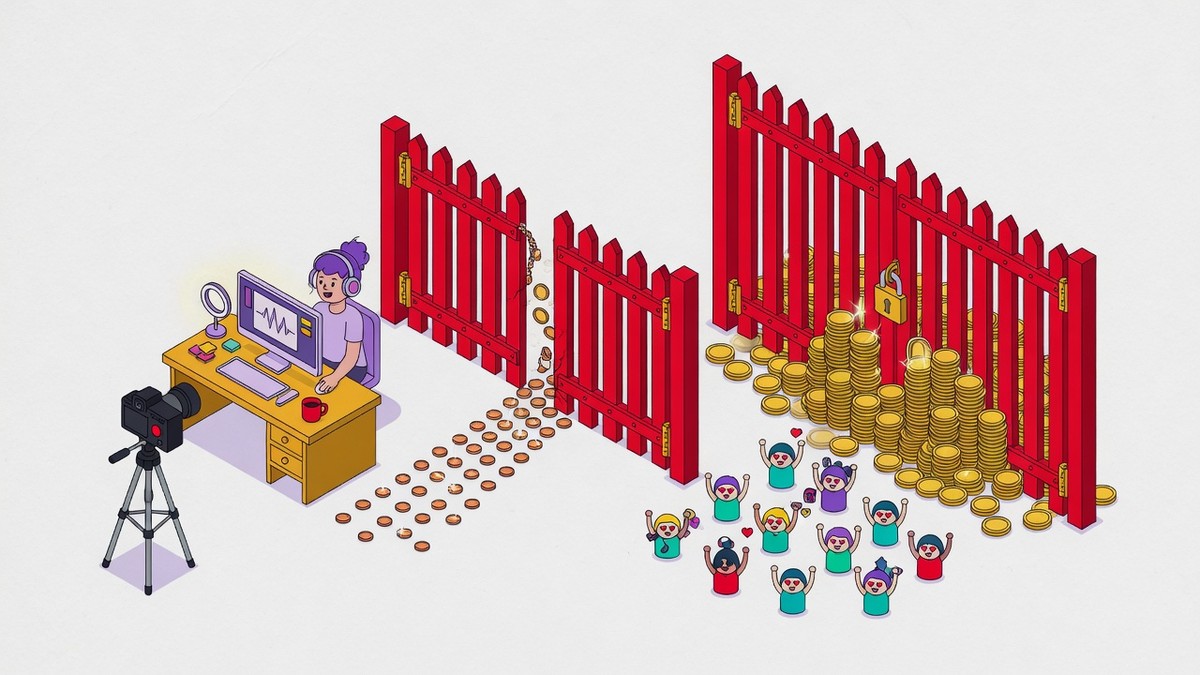
How Many Watch Hours to Monetize YouTube in 2026
How many watch hours to monetize YouTube in 2026: 4,000 valid public hours in 12 months plus 1,000 subs for ad revenue, or 3,000 hours at 500 subs for fan funding.
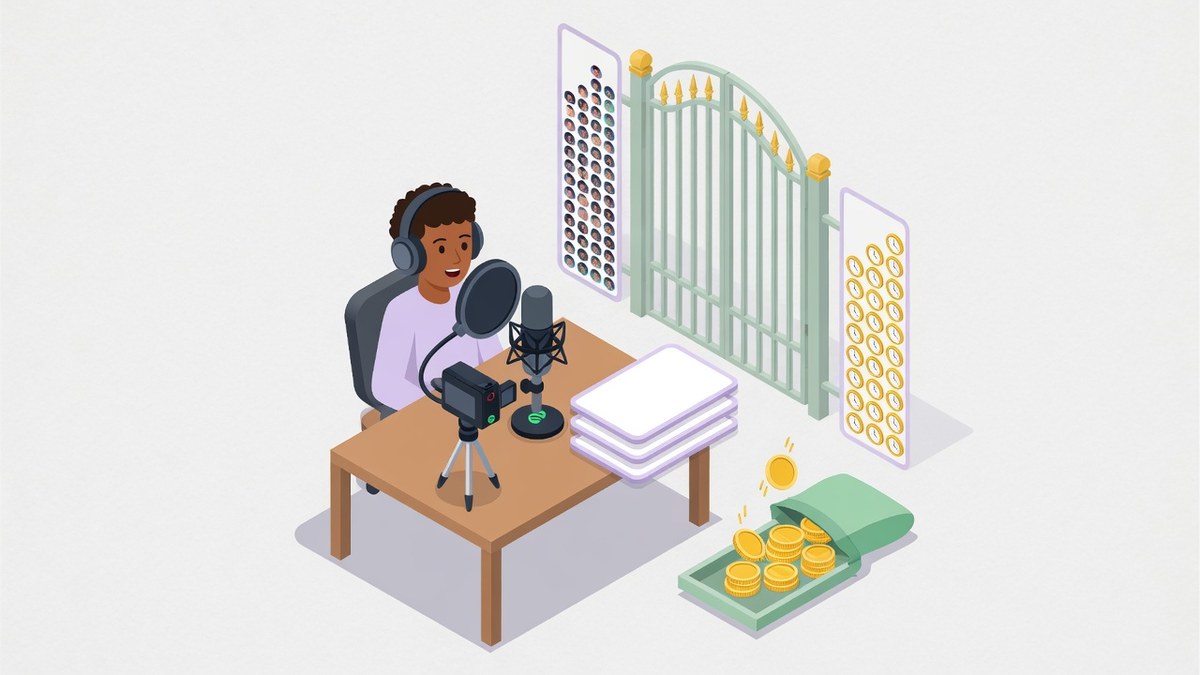
Spotify Partner Program Requirements 2026: Who Actually Qualifies
Spotify Partner Program requirements 2026: 3 episodes, 2,000 consumption hours, and 1,000 audience count in 30 days. Spotify cut the bar ~80% in January. Full breakdown.

Which Creator Programs Pay the Fastest? Instant, Weekly & Monthly Payout Guide (2026)
Ko-fi pays instantly. UnitedMasters SELECT pays daily. Fanfix pays weekly. YouTube pays monthly. Here's the complete 2026 guide to creator program payout speeds — verified, side-by-side.